Case study
The idea that kept me up at night:
personalising in-store shopping
with conversational AI
PASSION PROJECT |
BUILT & DEPLOYED WITH AI |
USER RESEARCH |
UI & INTERACTION DESIGN |
2 WEEKS
TL;DR
KEY PROBLEM
Shopping for clothes takes forever and still ends in second-guessing. Endless choice, and no easy way to tell what actually suits you. What's missing is what a good stylist does without thinking: read your context and point you to the right thing.
USER PROBLEMS & SOLUTION

"I love wearing outfits that feel like me.
I just wish shopping wouldn't take so
much time or second-guessing"
PARTICIPANT 4
WHAT USERS FEEL
IMPACT
20%
to be filled after usability testing

SOLUTION
What I built
Aisle, an in-store kiosk + smart mirror where a conversational AI curates outfits, enables
virtual try-on, and hands you off to staff for the physical trial.
Contents
Background
Problem
Opportunity
Concept
Solution
Wireframes
User testing
UI
Impact
Background
When you hate to shop, but love to dress
Years of loving to dress up but hating to shop (a curse of a combination I swear) made me think; what if I could get rid of the ugly parts? The endless shifting through racks to select a few, waiting in line at the trial room and finally trying them only to realise it doesn't quite fit you (your size is out of stock) or that it simply doesn't suit you (and you have no idea what will). Things get a bit better online shopping (thank God for filters). But a different set of problems arise there, we've all returned products that looked nothing like the picture.
So here I am, trying to combine the best of both worlds with a self-serve smart shopping kiosk that acts as a personalized style companion. A mouthful to say, a bit ambitious in its implementation (virtual try ons, trial room delivery?) but helpful for sure probably mostly.
Problem
Assumptions aside, what does a shopper feel, actually?
To better understand a customer’s perspective, I ran a survey of 30 participants. aged 23 to 30, and asked the survey group to share what they felt about their shopping experience, both online and in-store.
This is what I found
100% feel frustrated at some point in their shopping experience.
With 53.3% feeling frustrated often and 46.7% feeling frustrated sometimes.
Overwhelming choices (46.7%), lack of size availability (40%)
and not finding their style (40%) are among the
top reasons of frustration.
Followed by not knowing what suits them (26.7%), the crowd (13.3%) and the prices (6.7%).
The searching (53.3%), the time spent (40%) and not finding the right size (33.3%) are major reasons of frustration while shopping in-store.
Other reasons include travel to the store and price range.
The answers kept adding up to Aneesha.
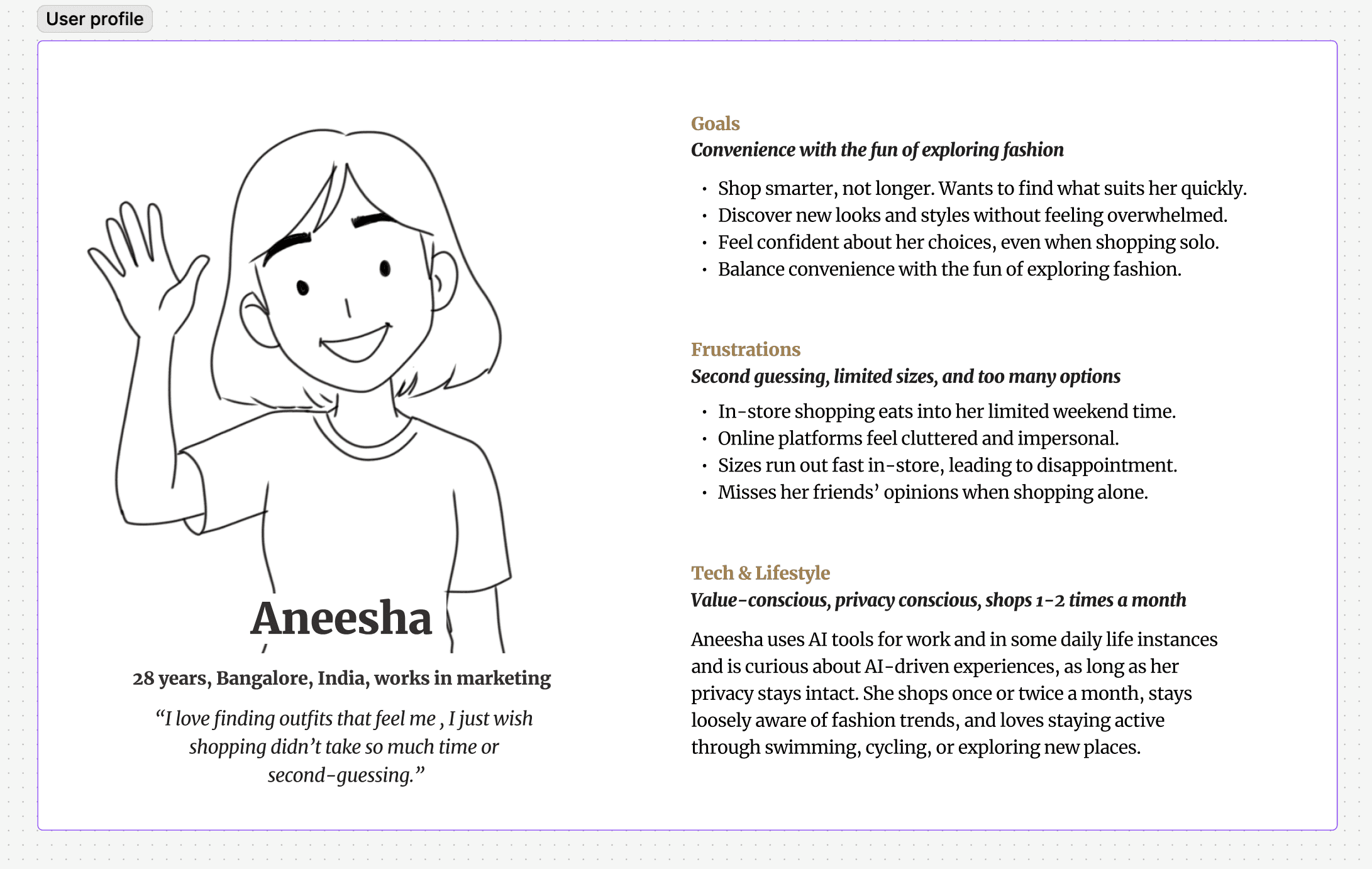
Meet Aneesha
Concept & Validation
What if shopping actually knew you?
An assistant shopper that helps users find outfits suited to their occasion, size, and preferences. It curates looks from in-store and online inventory, allows virtual try-ons, and seamlessly connects users to staff for physical trials or checkout — with options for in-store pickup or home delivery.
Video of Aisle
How does the average consumer feel about this?
100%
of respondents found the concept at least somewhat useful — 64% said “very useful”, and 36% said “kinda useful.”
63.6%
of shoppers are comfortable using in-store kiosks or digital displays, showing a good readiness for tech-assisted retail.
54.5%
said they’d likely use it, If it reduced shopping time, with an average rating of 3.7/5. This shows moderate-to-high intent to try the kiosk.
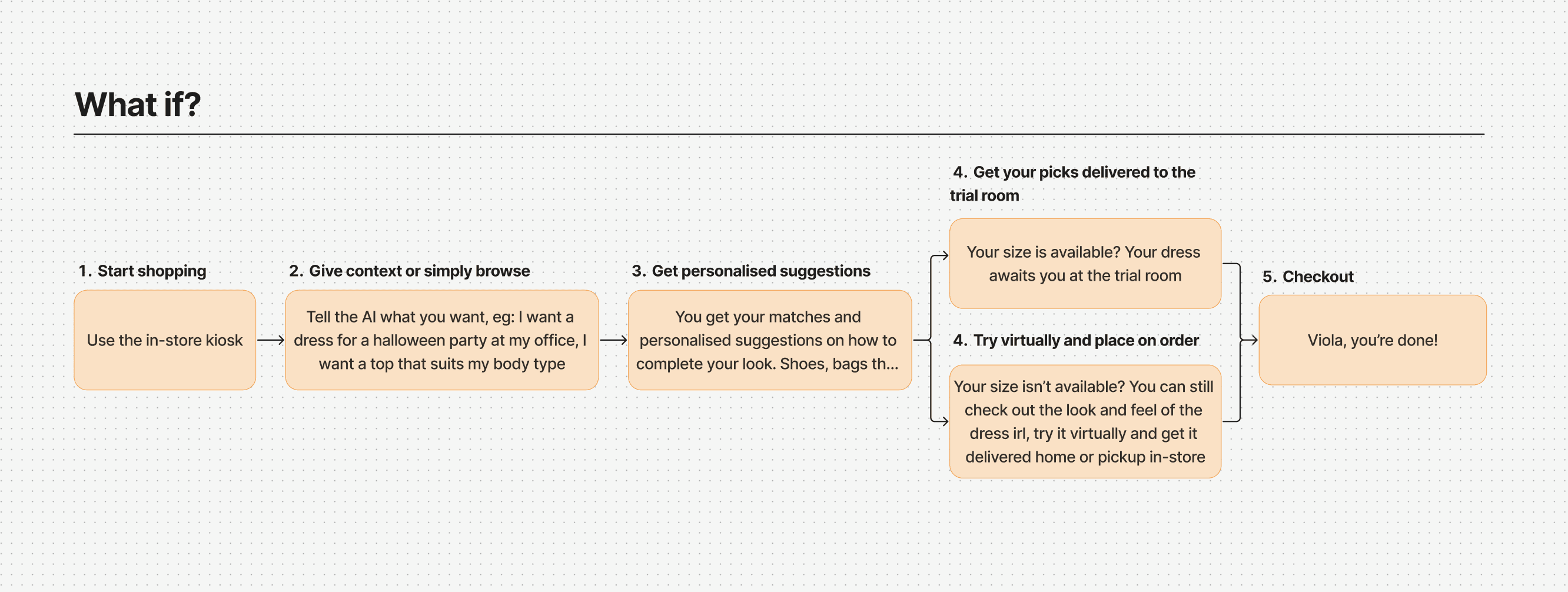
What if?
Solution
Redefining the in-store shopping experience
The new shopping experience
Before diving in to this idea, I first needed to know how open users would be to this. Is the average customer ready to accept AI assisted solutions?
Image of kiosk setup
Store layout
Wireframes and UI
Before diving in to this idea, I first needed to know how open users would be to this. Is the average customer ready to accept AI assisted solutions?
User feedback
Before diving in to this idea, I first needed to know how open users would be to this. Is the average customer ready to accept AI assisted solutions?
Images of user testing
The final edit
Before diving in to this idea, I first needed to know how open users would be to this. Is the average customer ready to accept AI assisted solutions?
Figma prototype
Impact
What this could mean for businesses and users
With the given opportunity and readiness to adopt new solutions, a smart kiosk could be the answer. But what would that solution look like?